
How to delegate when the mission feels too important to let go
I get this question a lot. How do you delegate?
And I’ll be honest: I’m not always good at it.
When something is new to me, I have the tendency to hold on more because I don’t yet trust myself to catch it if it goes wrong. So I try to control the thing instead.
When I know what I’m doing, it’s a different story. Then I can sit down with someone, agree on what we want, and let them go do it. Even when the result comes back at eighty percent of what I had in my head. Eighty percent, done by someone else, is a movement. A hundred percent, done by me, is a system that you created entirely on yourself.
So the first thing I’d say about delegating is this: it’s not one skill. It’s a different skill in every situation, and it depends on how safe you feel.
I see this constantly now, in the founders I work with at Social Movement Lab. People with hearts of gold, a mission they’d give anything for, and a growing pile of things only they can do. Not because nobody else could. Because letting go feels like letting the mission down.
That’s the shadow side of commitment. Once the cause is your identity, you can’t delegate a task without feeling like you’re handing over a piece of yourself.
Start with yourself, but don’t stop there
Before you look at the person you want to delegate to, look at you. Three questions:
In which situations is it harder for me to let go? For me: anything new, anything with my name on it, anything where I’ve been criticised before.
- What do I need in order to let go? A check-in halfway? Knowing they can call me? Agreeing up front what “good enough” means?
- Where could I let go a little more than I do now?
Knowing your own fears matters, because if you don’t, you’ll project them onto the other person. You’ll conclude they can’t do it, when really you couldn’t watch.
But self-awareness is only half of it. The other half has nothing to do with you.
The person in front of you
The core of delegating is always the same question: who am I actually handing this to?
Two things to find out. Can they do it? Do they want to?
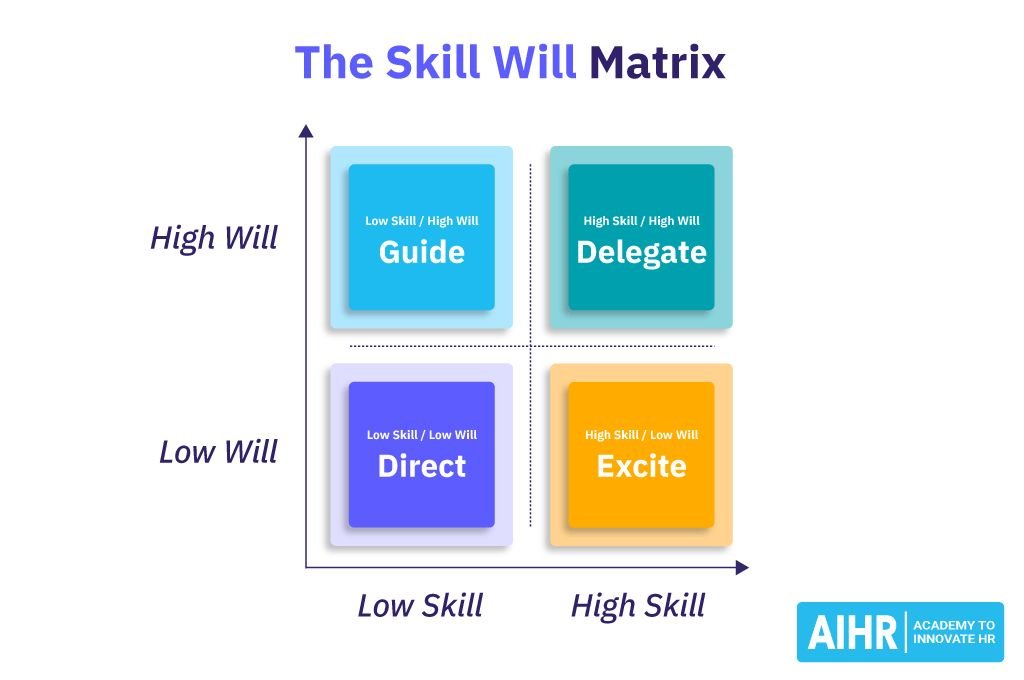
That gives you roughly four people, and they need four different things from you based on the skill/will matrix.

- Delegate: The one who can and wants to. Give them the goal, maybe discuss clear metrics and get out of the way. Your only job is not to interfere. Most of us interfere anyway, because it’s hard to watch someone do it differently. Sit on your hands.
- Exite: The one who can, but has gone quiet. They used to be your best. Now they’re slow to reply and they miss things. Don’t hand them more work. Find out what happened. Bored, unseen, tired, something at home? This is where your best people disappear, and they rarely tell you why.
- Guide: The eager one who can’t yet. They want to. They’ll make mistakes. This is your future, and it’s the person most founders skip because it’s slow. Clear expectations, a check-in every week, and room to get it wrong once. Nothing grows your organisation like this person.
- Direct: The one who’s in the wrong place. Can’t, and doesn’t really want to. Not a bad person. A bad match. The kindest thing you can do is have the honest conversation, this month, instead of another year of chasing them.
Delegation fails when we treat these four the same. We give the eager beginner a task without support and conclude they couldn’t do it. We give the quiet one more work and wonder why they left. We check up on the one who could have flown.
The reality check
Then, right before you hand something over, one more question. Ask it out loud if you have to.
If they do this without me and it goes seventy to eighty percent right, does the movement actually get hurt? Or does my need for control get hurt?
Nine times out of ten it’s the second one. And the tenth time, when it’s genuinely too risky, you’ll know, and then you keep it. That’s fine too. But you’ll be keeping it for a reason, not for a feeling.
Try this week
- Pick one thing on your plate that someone else could do. Not the biggest thing. One thing.
- Place the person on the two questions: can they, do they want to. Choose how you’ll delegate, and agree what “done” looks like before they start. Then, and this is the part that matters, leave it alone until the check-in you agreed on.
- If it comes back at seventy/eighty percent, ask yourself what was unclear before they started. Usually it’s the design, not the person.
A movement that depends on one person is a fragile thing. Not because that person is weak. Because there’s nowhere for anyone else to stand.
What’s the one thing you’re holding on to right now that you know someone else could carry? I’d like to hear it. Send me a message via emmy@socialmovementlab.org or my insta emmy_mol_